Learning Piano: 5 Secrets to Sounding
Like a Pro in Days
Why Everything You Know About Learning Piano is Backwards
Many aspiring musicians spend years in a state of perpetual frustration, investing exhaustive effort into traditional lessons only to find themselves unable to play a single song that sounds professional. The typical pedagogical approach is often the culprit: it front-loads abstract music theory and complex sheet music, creating a high cognitive load that stifles the joy of making music. Most beginners are forced to navigate an arduous path of scales and nursery rhymes, which rarely translates into the sophisticated sound they actually want to achieve.
There is, however, a more efficient, evidence-based methodology that prioritizes the "playing" experience over the "practice" grind. This approach, pioneered by the program Pianoforall, has been utilized by over half a million students worldwide to bypass the traditional hurdles of music education. By leveraging adult learning theory and sensory engagement, this method simplifies the complex, allowing students to sound like intermediate players in a fraction of the time.
To Visit the Website, CLICK HERE.
The "Language First" Acquisition: Speaking Before You Read
In traditional music education, students are often forced to decode notation before they have even felt the keys. From a learning strategist’s perspective, this is fundamentally counter-intuitive. Human beings are biologically wired to acquire language through sound and imitation long before they learn to read or write.
Pianoforall utilizes a "Visual Association" technique that mirrors this natural acquisition process. This method focuses on playing by ear first, allowing students to build a musical foundation and sensory connection with the instrument. Crucially, this isn't about delaying literacy; the program teaches students to read music simultaneously as they learn to play by ear. This dual-track scaffolding reduces the intimidation of sheet music and ensures that when students look at a page of notation, they already have the physical confidence to execute the sounds.
"I’m virtually ecstatic with how I’ve finally managed to play after a year of slogging away trying to learn to read music. I’ve given up on that and I’m really learning so quickly now by applying what you teach." — Toni Le Busque
The "Rhythm-Style" Framework: Scaffolding to a Professional Sound
One of the most significant psychological barriers for adult learners is the "juvenile repertoire" trap. Being forced to play "Mary Had a Little Lamb" kills motivation. To maintain engagement, an effective learning strategy must provide immediate "wins."
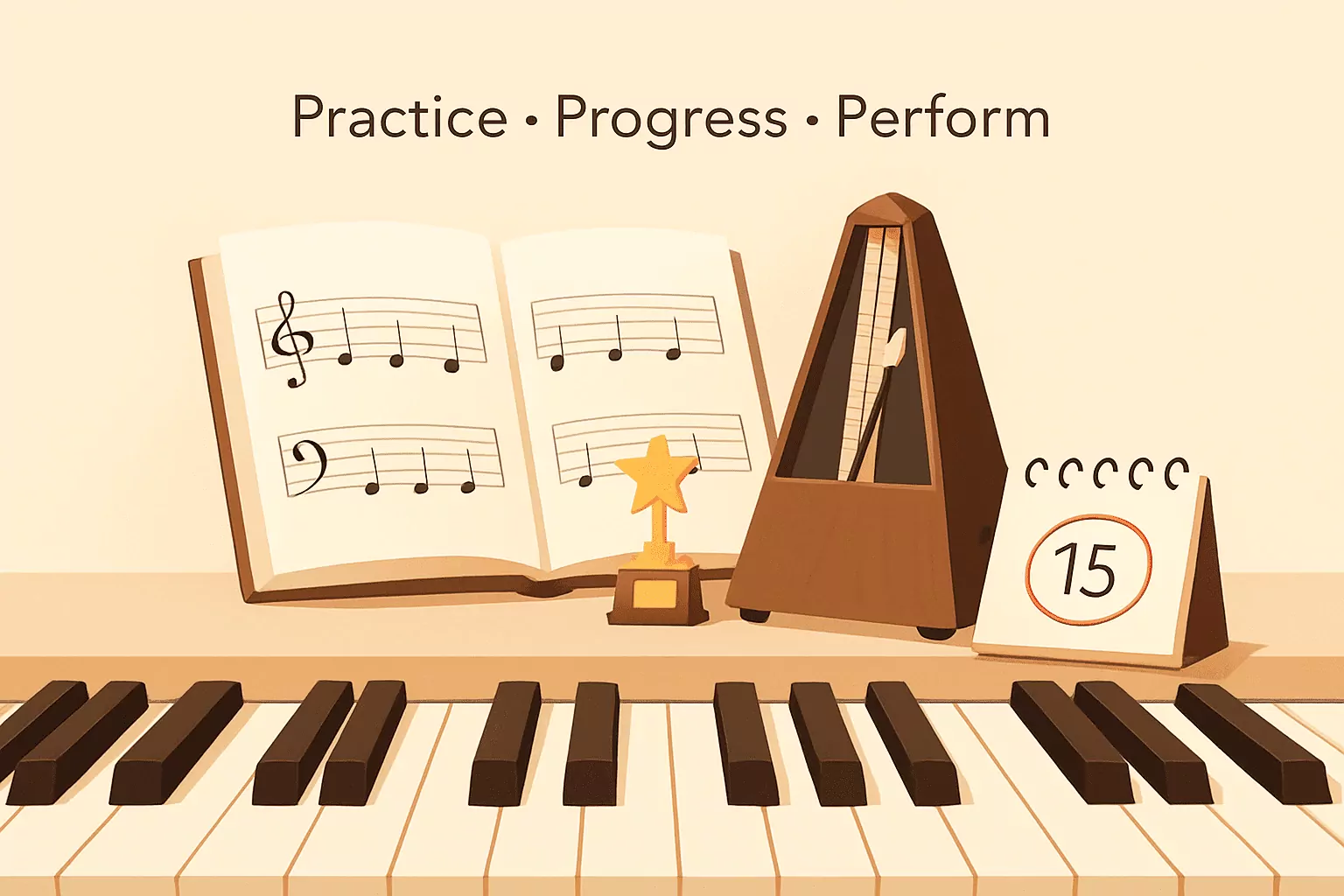
The secret lies in starting with "Rhythm Style" piano. By mastering 15 iconic popular rhythms, learners can sound like professionals within days. Using a combination of formulas, clever "bluffs," and classic song progressions, students can tackle everything from the Beatles to Beethoven. This approach allows beginners to dive into the sounds of Jerry Lee Lewis, Little Richard, and Fats Domino right away. By establishing a rhythmic foundation first, the transition into more complex genres like Jazz, Blues, and Rock ‘n’ Roll becomes a natural evolution of skill rather than a steep uphill climb.
"The songs are not 'Mary had a Little Lamb' types! From the Beatles to Beethoven, it’s all there... Once you get the rhythms down, you really can sound like a pro!" — T. Dwight Kidd
Spatial Mastery: Mapping the Keyboard Through Shapes and Patterns
Traditional notation can often feel like a dense code that creates a barrier between the player and the instrument. A superior educational strategy involves teaching students to see the keyboard as a visual map of interconnected shapes and patterns.
Pianoforall employs a multi-sensory approach, combining video, audio, and keyboard diagrams to cater to visual learners. Students utilize specific tools like a "magical piano chord chart" and "speed learning exercises" to master chord inversions and improvisations rapidly. Instead of seeing 88 disconnected keys, the student learns to recognize the underlying structures of music. This spatial awareness allows for "speed learning" that facilitates the ability to create original melodies and improvise with ease, moving beyond the limitations of rote memorization.
"Within an hour, I was making music. My whole family can’t believe I really learned all I have in less than 3 days!" — Pastor JD Loveland
Functional Theory: Understanding the "Why" of the Composition
Many learners become "human jukeboxes"—capable of mimicking a specific sequence of notes but entirely lost if they have to deviate from the script. To achieve true musicality, a student must understand functional music theory.
This method goes beyond the "how" and dives into the "why" behind the music. By understanding chord structures and the DNA of different genres, students gain the agency to create their own compositions. This is an essential bridge for musicians who already play other instruments; for instance, a guitarist in Nashville can leverage this functional understanding to create professional piano-style demos and write songs more effectively. When you understand the building blocks, you aren't just copying—you are communicating.
"I play the guitar but I wanted to start writing on piano. This is a great course for that... this is a great way to learn piano fast for song writing." — Mike, Nashville
Removing Friction: The End of the Subscription Trap
The modern learning landscape is often marred by "subscription fatigue" and the ongoing pressure of expensive private lessons. These models often prioritize the instructor's bottom line over the student's accelerated learning curve, leading to uncertainty and financial strain.
A more effective model for the self-directed learner is a comprehensive, self-contained curriculum. Pianoforall operates on a one-time payment model, providing interactive ebooks that work on any device—PC, Mac, iOS, or Android—with a "No Need To Be Online" feature. This removes the friction of modern connectivity issues and allows for total immersion. Furthermore, the inclusion of a 60-Day Money Back Guarantee eliminates the "risk-anxiety" that often prevents frustrated pianists from taking the first step toward a new method.
A New Era for the "Frustrated Pianist"
The barrier to musical entry has been permanently lowered. Whether you are "74 years young" and looking for a fulfilling new hobby, or a lead singer in a band seeking the "mysterious shortcuts" to piano mastery, the strategy remains the same: simplify the complex. By prioritizing rhythm, visual mapping, and functional theory, the transition from beginner to intermediate no longer requires years of joyless labor.
We are entering an era where the joy of performance is accessible to everyone, regardless of their past "failures" with traditional methods. CLICK HERE TO LEARN MORE.
If you could sound like a professional in just a few days, what is the first song you would choose to play for a room full of people?